En Garde: What to Expect in Your Child’s First Beginner Fencing Class
So, your child wants to be a fencer. Perhaps they’ve been inspired by their iPad hero, or maybe they’re looking for a sport that rewards strategy and mental sharpness as much as physical speed. Whatever the spark, heading to their first kid’s beginner fencing class in Singapore can feel like stepping into another world.
As a parent, you likely have questions: Is it safe? Do I need to buy expensive gear immediately? What actually happens during those sixty minutes? If you’re feeling a mix of excitement and “what have I gotten us into?”, don’t worry.
Here is a comprehensive guide to exactly what you and your child can expect during their first beginner fencing class.
1. The Environment
The first thing you’ll notice when you walk into a fencing club is the sound. It’s a rhythmic symphony of metallic “clinks,” the squeak of sneakers on specialized mats (pistes), and the occasional buzz of an electronic scoring box.
Unlike the chaotic energy of a soccer field or a gymnastics meet, a fencing school usually feels focused and disciplined, yet buzzing with energy. It’s an environment that immediately makes a child feel like they are part of something unique and cool.
2. Safety First
Before a blade is even touched, the fencing instructor will likely talk about safety. This is the most important part of the first day.
Parents are often surprised to learn that statistically, fencing is one of the safest sports in the world, ranking lower for injuries than sports like golf or soccer. This is because the:
- Equipment is robust: Fencing uniforms are made of heavy-duty cotton or Kevlar. The masks are also designed to withstand significant impact and are tested to high-pressure standards.
- Fencing blades aren’t sharp: In a beginner class, children use practice blades. These are flexible, blunt, and have a rubber or plastic tip at the end. There is no cutting or piercing involved.
3. Gear Needed
One of the biggest barriers for new parents is the equipment needed. The good news? For a beginner class, you shouldn’t have to buy a thing. Most reputable clubs provide loaner gear for the first few months.
In the first class, your child will be fitted for:
- Mask: A steel mesh helmet with a bib to protect the neck.
- Jacket: A padded, white tunic that zips up the back or side.
- Glove: Worn only on the fencing hand to provide a better grip and protect the wrist.
- Blade: The starter weapon. It’s lightweight and easy for smaller hands to maneuver.
Pro-tip: For the first lesson, simply dress your child in comfortable athletic pants (not shorts!) and sneakers with good grip. Fencing involves a lot of lunging, so “breathable” is the keyword.
4. Warm-Up
Fencing is often called “physical chess”, To play chess at high speeds, you need a body that is ready to react. Don’t be surprised to see the kids playing “Fencing Tag” or doing footwork drills that look like a stylized dance. These games are designed to build fencers’ muscles, specifically the quads, calves, and core—without the kids even realizing they’re working out.
5. Footwork
Many beginners are surprised to find that they don’t pick up a sword for the first 20 minutes. That’s because, in fencing, your feet are your most important weapon.
Your child will learn the three basic movements:
- En garde: The fundamental stance. It’s a balanced, crouched position that allows for instant movement.
- Advance and retreat: How to move forward and backward while maintaining balance.
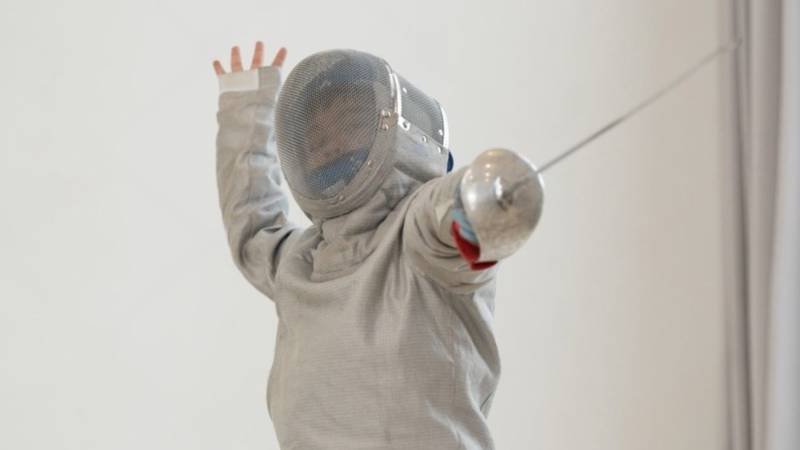
- Lunge: The explosive forward move used to touch the opponent.
Watching a group of kids learn to lunge for the first time is a highlight for many parents. It’s a moment of pure, focused athleticism.
6. Blade Work
Once the footwork is steady, the blades come out. In the first class, the coach will focus on:
- Grip: How to hold the foil (like holding a small bird—firm enough so it doesn’t fly away, but gentle enough so you don’t crush it).
- Extension: Straightening the arm to point at the target.
- Touch: Learning how to land the tip of the blade on the opponent’s torso (the “valid target” in foil fencing) with just enough pressure to bend the blade safely.
8. The Bout
Toward the end of the session, the coach will likely let the students spar. This is the moment every kid waits for. They get to put all the footwork and blade work together in a real match.
In many beginner classes, they may even get a chance to hook up to the electronic scoring system. When their blade touches the opponent’s jacket, a green or red light flashes on the box with a loud beep. For a child, there is no feeling quite like seeing that light go off and knowing they scored a point.
Ready to see your child pick up the blade?
Fencing is one of the few sports where a child can be a tactician, an athlete, and a sportsperson all at once. Don’t let them miss out on the sport of a lifetime.